
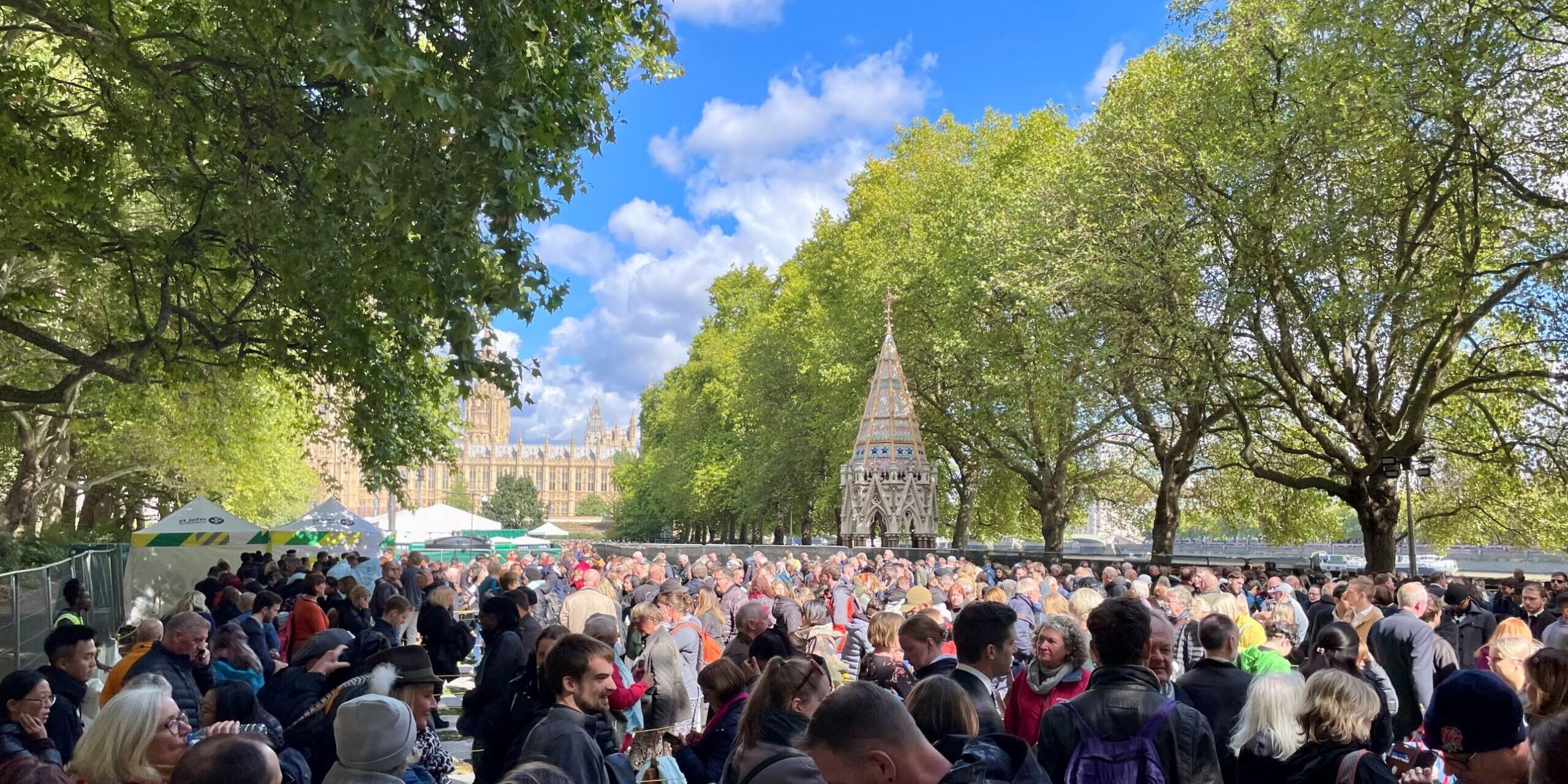
The overwhelming response to the Queen’s death has shone an important spotlight on the role of collective grief and the importance of confronting the reality of death.
One of the most important roles a funeral service plays is the coming together of a community to pay respects, show support to the grieving family and say goodbye. Funeral directors frequently have conversations with bereaved families about the importance of everyone, who wants to attend, being able to be there when deciding on a suitable date for a funeral.
The removal of that opportunity during the pandemic, for the majority of mourners, made front page headlines of funerals, not least that of the Duke of Edinburgh, which saw the Queen sitting alone for the funeral service, due to COVID restrictions. It has left what has been described as a legacy of unresolved grief for many people affected by loss during the pandemic, that bereavement charities believe will take many years to fully address.
Julia Samuel, a psychotherapist who specialises in bereavement, highlights the important role that gathering together can play in the grieving process after a death – even if it is for a public figure you don’t know personally, like The Queen. “What research shows is that having experiences of loss, you do worse alone than when you have the love and connection to others,” she told The Guardian. “In a close bereavement, you would want this to be with friends and family, but I also think there is something about strangers feeling like they know each other, when they’re coming to put flowers at Buckingham Palace.”
That is a view shared by scientists too. “Mourning plays an important role in bereavement because it’s a way of externalising the emotions and thoughts of grief and, through that, incorporating the loss into your life and beginning to heal,” says Dr Lucy Selman, an associate professor in end-of-life care at the University of Bristol and the founding director of Good Grief Festival.
Yet the voices of those who say being there doesn’t matter, that you don’t need attend a funeral to say goodbye, have grown ever louder in recent years. The public has even been encouraged to view funeral services as an inconvenient expense by those promoting the alternative – which in some cases is little more than the discreet disposal of a body. For some people, that may be right – but the funeral profession fully understands that, for the majority of people across the UK, the need to be there in person to say goodbye is tangible, is important and should not simply be dismissed as ‘fuss’ (to quote the marketing of one particular provider).
Indeed, if proof was ever needed of the value of being present to say goodbye or pay respects, then the queues to attend HM the Queen’s lying in state in Edinburgh and in London, the public that lined the routes from Balmoral to Edinburgh, from RAF Northolt to Buckingham Palace and on to Westminster Hall, and the crowds that descended on London and Windsor on the day of the Queen’s funeral, provided ample evidence that being able to participate, in some way, in the customs and traditions which follow a death remains important to many people.
“Rituals hold us together and they give us this sense of meaning,” adds Samuel. “They’re incredibly important in the process of grieving because part of the task of grieving is facing the reality of the loss,” – which seeing the Queen’s coffin, or indeed the coffin at any funeral, delivers. “You can’t not know that someone has died – it’s not surreal anymore, which is often the first response to death. And so that helps you adjust to this new reality.”